
Mann Roofing and Remodeling

Storm damage guide

How to Spot Storm, Wind and Hail Damage on Your Roof

Done right the first time, not the third.

  • Free storm-damage inspections
  • CertainTeed and Owens Corning certified
  • Serving Buffalo since 2007
The walk-around

After the wind dies, read the roof from the ground

Storm, wind and hail damage on a Buffalo roof usually appears as missing or lifted shingles, cracked or bruised shingle faces, piles of granules in gutters, and dented flashing or vents. The National Weather Service reports Buffalo averages 85 to 95 inches of snow a year, so wind and freeze-thaw stress compound every storm.

Storm, wind and hail damage on a roof shows up in five recognizable places: the shingle field, the gutters, the flashing, the roof penetrations, and the attic below. After a Western New York storm, walk your property and look for shingles that are missing, lifted, or creased, dark bruise marks where hail struck, and granule grit washing into downspouts. The National Weather Service office in Buffalo records an average of roughly 85 to 95 inches of snow each winter, and the wind and freeze-thaw cycles that come with it put constant stress on every seam and fastener.

Buffalo sits in one of the most punishing roofing climates in the country. The snowbelt south of the city can bury a roof while neighborhoods a few miles north stay comparatively clear. The National Weather Service documented this split in November 2022, when Buffalo Niagara International Airport measured about 36 inches while Orchard Park recorded roughly 82 inches during the same lake-effect event. The NRCA notes that local climate can shorten or extend a roof's service life by up to 40 percent, which is why storm inspection matters more here than in milder regions.

The whole check happens from the driveway. Binoculars, not ladders. Illustrative.
Six stops, all from the ground
  1. Do a safe ground-level check

    After the storm passes, walk the full perimeter of your home from the ground with binoculars. Note any shingles in the yard and photograph each side of the roof. The NRCA advises inspecting only from ground level, never from a wet or storm-loosened roof.

  2. Look for missing, lifted or creased shingles

    Scan the shingle field for gaps, shingles folded back or cracked across the middle, and bare spots. Wind breaks the adhesive seal and lifts tabs, while missing shingles expose the underlayment and deck to the next rain.

  3. Check gutters and downspouts for granule loss

    Look inside gutters and at downspout outlets for piles of sandy granules. Heavy or recurring granule accumulation after a hail or wind event, per InterNACHI, signals that shingles are losing their protective surface faster than normal wear.

  4. Inspect flashing, vents and penetrations

    Check the metal flashing around chimneys, walls, valleys and skylights, plus pipe boots and roof vents, for dents, lifting or gaps. Damaged flashing is one of the most common hidden sources of roof leaks after a storm.

  5. Check the attic for leaks and daylight

    Go into the attic with a flashlight and look for water stains on the underside of the deck, damp or matted insulation, and daylight coming through the roof. Catching moisture here confirms storm damage before it reaches your ceilings.

  6. Get a free professional inspection

    Have a certified roofer document the damage the way insurers expect. Mann Roofing and Remodeling offers free storm-damage inspections in Buffalo; call (716) 500-6266 to schedule before filing an insurance claim.

The damage catalog

What storm, wind and hail leave behind

Close detail of a storm-worn asphalt shingle field, illustrative

Hail bruises on the shingle field

Hail is the damage homeowners miss most often because it rarely leaks right away. According to the Insurance Institute for Business and Home Safety, hail roughly one inch across, about the size of a quarter, is the common threshold for functional damage to standard asphalt shingles, and insurers often use that mark as an informal cutoff. IBHS research reported in 2025 found that even sub-severe hail under one inch can reduce a shingle's resistance to future storms and accelerate normal aging. On the roof, hail leaves round bruises, soft spots that feel like a bruise on an apple, and knocked-loose granules that expose the black asphalt mat underneath.

Field term: Hail bruise
A soft, rounded spot on an asphalt shingle where a hailstone struck and fractured the mat beneath the granules. It often feels spongy like a bruise on fruit and may not leak right away, which is why hail damage is easy to overlook.

A roof slope under a dark clearing storm sky, illustrative

Wind creases and lifted tabs

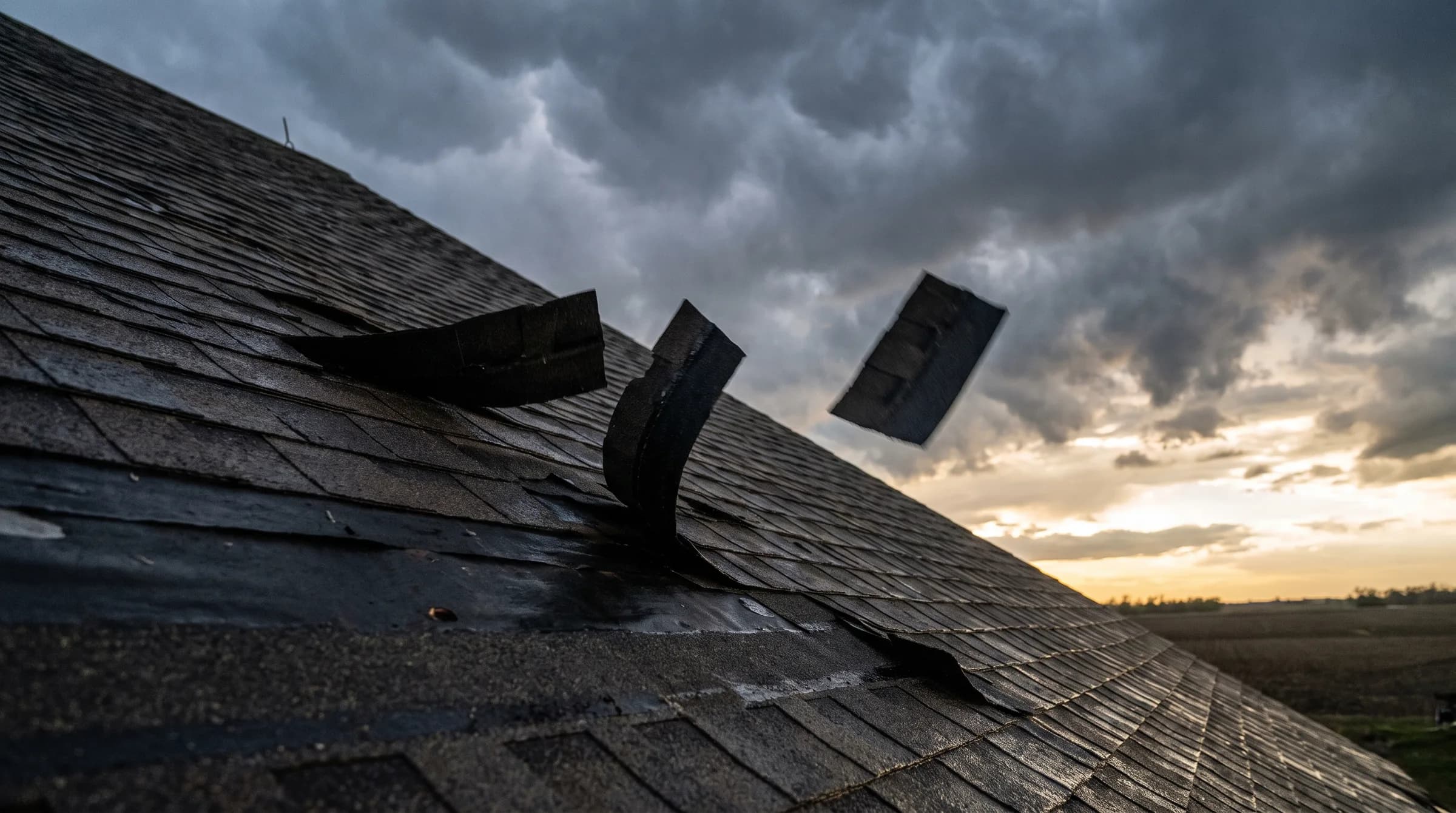
Wind damage is easier to see from the ground. Look for shingles that are folded back, creased across the middle, or gone entirely, plus shingles lying in the yard or driveway. Asphalt shingles seal to each other with a strip of adhesive, and once a gust breaks that seal the tab lifts and flaps until it tears free or lets water underneath. Architectural shingles are rated by manufacturers and tested under ASTM wind-resistance classifications, but age, poor installation, and repeated Buffalo gusts all lower the wind speed a roof can actually withstand.

Field term: Wind uplift and creasing
Wind uplift is the force that breaks a shingle's adhesive seal and lifts the tab. A creased shingle is one that was folded back by wind and cracked along the fold, leaving it prone to tearing off in the next storm.
A roof edge and gutter line after severe weather, illustrative

Granules washing into the gutters

Granule loss is the third signal, and your gutters tell the story. The mineral granules bonded to asphalt shingles shield the asphalt from ultraviolet light, so when they wash away the shingle ages fast. InterNACHI, the international home inspectors association, notes that heavy granule accumulation in gutters and at downspout outlets, especially after a hail or wind event, is a warning sign rather than routine wear. A handful of grit on a brand-new roof is normal. Piles that keep returning after you clean the gutters are not.

Field term: Granule loss
The wearing or knocking away of the protective mineral granules bonded to an asphalt shingle. Because the granules block UV light, heavy or recurring granule loss, especially collecting in gutters, exposes the asphalt and shortens the roof's life.
A home under a heavy Western New York storm front, illustrative

Flashing, vents and the attic below

Flashing, vents and the attic round out the inspection. Flashing is the metal that seals the joints where a roof meets a chimney, wall, valley or vent, and storms bend, loosen or tear it, opening a direct path for water. Check that pipe boots, ridge vents and box vents are still seated and undented. Then go inside: in the attic, look for water stains on the underside of the deck, damp insulation, or daylight showing through. The NRCA reports that proper attic ventilation can extend a roof's life by up to 25 percent, so a blocked or storm-damaged vent is more than a cosmetic problem.

Field term: Flashing
The thin metal installed to seal joints where a roof meets a chimney, wall, valley, skylight or vent. Storms can bend, lift or tear flashing, creating one of the most common hidden entry points for roof leaks.
Reading the catalog right

Timing matters after a storm. Document what you find with dated photos from the ground, and do not climb onto a wet, steep or storm-loosened roof to get a closer look. The National Roofing Contractors Association advises that homeowners and business owners should only perform a roof inspection from ground level, because the fall risk without professional fall-protection gear is too high. If you plan to file a homeowners insurance claim, most carriers expect prompt reporting, and the NOAA Storm Prediction Center's public hail and wind records for your county can help confirm the date and severity of the event.

Knowing your roof's age helps you judge what you are seeing. The NAHB and NRCA put architectural asphalt shingle life at roughly 22 to 25 years, standard three-tab closer to 20, while the Metal Roofing Alliance rates metal roofs at 40 to 70 years. A single storm on a 20-year-old shingle roof often tips it from repairable to due for replacement, while the same storm on a five-year-old roof is usually a spot fix. An inspector who measures the damage against the roof's remaining life keeps you from overpaying or underinsuring.

Professional roofing contractors are trained to identify roof damage that may not be obvious to a homeowner or building owner.
National Roofing Contractors Association (NRCA)

The storm file, at a glance

Buffalo avg. snowfall
About 85 to 95 inches per year (NWS Buffalo)
Hail damage threshold
About 1 inch, quarter size (IBHS)
Architectural shingle life
About 22 to 25 years (NAHB/NRCA)
Metal roof life
40 to 70 years (Metal Roofing Alliance)
Attic ventilation
Extends roof life up to 25% (NRCA)
Serving Buffalo since
2007
Certifications
CertainTeed and Owens Corning
Storm inspections
Free
Financing
HEARTH: 0% interest, 12 months, no payments
Phone
(716) 500-6266
Straight answers

Storm and hail damage questions

What size hail damages a roof?

Hail about one inch in diameter, the size of a quarter, is the common threshold for functional damage to standard asphalt shingles, according to the Insurance Institute for Business and Home Safety. Older or brittle roofs can be bruised by smaller hail, and high winds during the storm increase the damage.

Can my roof be damaged without leaking?

Yes. Hail bruises, broken shingle seals and lost granules frequently cause no immediate leak, but they shorten the roof's life and let water in during later storms. This is why a roof can pass a quick glance yet still need repair after a hail or wind event.

How soon after a storm should I inspect my roof?

Inspect within a few days. Prompt ground-level checks catch missing shingles and displaced flashing before the next rain drives water inside, and most homeowners insurance carriers expect storm damage to be reported promptly. Dated photos taken soon after the storm also support an insurance claim.

Should I climb on my roof to check for damage?

No. The National Roofing Contractors Association advises homeowners to inspect only from ground level, because a wet, steep or storm-loosened roof is dangerous without professional fall-protection equipment. Use binoculars from the ground, then have a certified contractor perform the close-up inspection safely.

What does hail damage look like on shingles?

Hail leaves round dark bruises where granules were knocked off, soft spots that dent slightly under a fingertip, and scattered granules in gutters and downspouts. On metal vents and flashing it shows as small dents. The marks are random and scattered, unlike the straight lines of foot traffic or normal wear.

Does insurance cover storm and hail damage in Buffalo?

Most homeowners policies in New York cover sudden storm, wind and hail damage, though coverage and deductibles vary by policy. Report the damage promptly, keep dated photos, and have a contractor document it. NOAA storm records for your county can confirm the date and severity of the event.

Free estimates · Since 2007

Storm passed? Get the roof checked, free.

Mann Roofing and Remodeling has inspected and repaired Buffalo roofs since 2007 and offers free storm-damage inspections. As a CertainTeed and Owens Corning certified contractor, the team documents hail, wind and storm damage the way insurers expect and installs manufacturer-backed systems. For homeowners spreading out the cost of a repair or replacement, HEARTH financing offers 0% interest for 12 months with no payments. To schedule a free inspection after a storm, call (716) 500-6266.

Call the MannFree Estimate